Skip to content
Jul 2 / Me

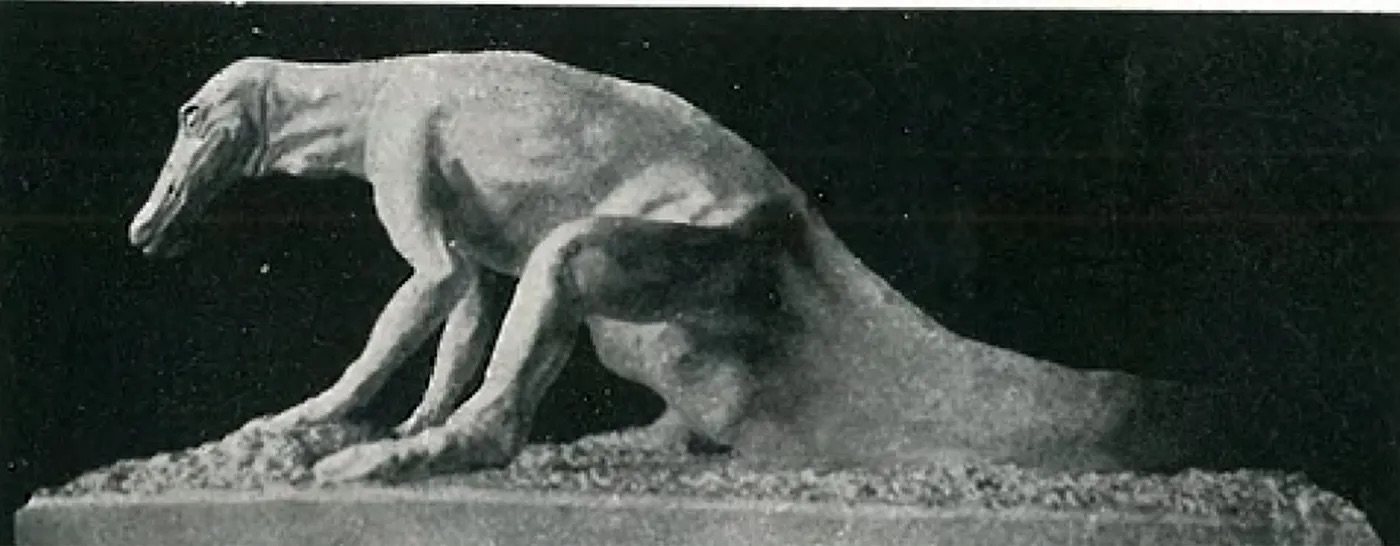
Heilmann’s Origin online


A part of this site is devoted to the Danish artist Gerhard Heilmann (check the menus if you want to know more about him). In honesty, I’ve said most of what I’m going to say about him, and Christopher Ries has said much more far better. However, Heilmann’s 1926 book The Origin of Birds is still a seminal work in the history of palaeontology for a number of reasons: the defining influence it had in the debate on the origin of birds, the combination of text and illustration, and its strong and consistent argument.

It is really a book that anyone interested in bird origins or the history of palaeontology ought to read; I scanned and OCR’ed it so that everyone can. Click here to download the entire book in searchable PDF format. Be aware that as PDFs go, it’s a whopper at just over 50 MB.

Apr 19 / Me

The Strunz Alternative (1936)

DSC_0006

In 1934, Frankfurt preparator Christian Strunz was commissioned with the task to re-mount the Senckenberg Museum’s Diplodocus. Torn between traditional American views and a more idiosyncratic approach, Strunz devised a way which saved him from having to make a choice between the ‘German’ and ‘American’ approach – more about which later

Oct 2 / Me

Mounting Iguanodon, 1882

iguanodon_1882

Workmen mounting the first Iguanodon bernissartensis skeleton in the St. George Chapel in Brussels, 1882. Because Belgium did not really possess a tradition in mounting vertebrate specimens, Dollo’s men had to invent their own method. Although they successfully mounted a great number of specimens (who are now on display in the Brussels Museum of Natural History), their solution meant that unmounting the animals was near to impossible without physically damaging them. These days, the Brussels Iguanodons have become museum specimens in more than one way, illustrating the evolution of mounting such animals in museums in the nineteenth century.

Aug 19 / Me

Another Burian Diplodocus – or is it?

diplo_burian2

From: G.E. Quinet (ca. 1970), Bernissart… il y a 125.000.000 d’années (Brussels: Royal Belgian Institute for Natural Sciences), opp. p. 71.

This Diplodocus carnegii is almost an exact mirror image of Zdeněk Burian‘s famous early 1960s reconstruction. It might be an earlier version of the same reconstruction, and I can’t be sure whether it was mirrored by Burian or this particular book’s designer (I would think the latter, to be honest). However, it is unsigned, the publication itself gives no clue as to its provenance, and I have seen it nowhere else in listings of Burian’s work. So the jury is still out.

Aug 19 / Me

From Diplodocus to dust

A not altogether reassuring view from the new Lichthof at the Berlin Museum…

Mr. Holland would not have let it come to this, surely.

To be honest, from the insurer’s point of view this seems to be a somewhat disturbing ad, I would think.

Aug 2 / Me

Plateosaurs roaming, 1928

plateos

G. Biese, illustration accompanying Friedrich von Huene’s 1928 description of German saurischians (F. von Huene 1928, »Lebensbild des Saurischier-Vorkommen in Trossingen«, in: Palaeobiologica I, Table XI.)

Jul 16 / Me

The glorious art of Zdenek Burian – and its not so glorious follow-up

burian_diplodocus

Diplodocus carnegiei by Zdenek Burian (oil on canvas, 1969)

In the mid-1970s, when I was five or six years old, my mother bought a remarkably expensive book about past life for me, called Leven in de oertijd (published in English as Life before Man). Text was by Zdenek Spinar, but more importantly the illustrations were by the Czech artist Zdenek Burian (1905-1981) and were my first confrontations with all those wonderful animals of the past. It has to be said that Burian’s forte was in depicting Kenozoic animals and early humans, but the dinosaur illustrations and those of other animals of earlier times are very good, too. Burian’s inspiration by Charles Knight is obvious from many pictures, and his way of working with antagonists (T-Rex opposing a single Triceratops, that sort of thing) is similar too. But in all I find Burian’s paintings, with their hushed tones, more evocative. However, this is a judgment pickled in nostalgia, of course. Show ▼

Jul 14 / Me

The ravages of war: the sad end of a Berlin whale, 1945

berlinwhale

The remains of a model of a whale in the inner courtyard of the bombed-out Natural History Museum in Berlin, 1945 (Museum für Naturkunde, Historische Bild- und Schriftsammlungen).

The museum, which is home to some of the greatest palaeontological specimens in the world (e.g., the most famous Archaeopteryx lithographica specimen and the huge Brachiosaurus brancai from Tendaguru, Tanzania) is still in a state of reconstruction. Recently, it central hall (‘Lichthof’) was reopened after an extensive overhaul.

Repost from my now-defunct Past Worlds blog

Jul 12 / Me

Iguanodon model in the Berlin museum, 2009

090426_Berlin-91

A model of Iguanodon bernissartensis by Joseph Pallenberg, around 1930. Currently on display in the Berlin Museum of Natural History.

Jul 6 / Me

BOO!

boo1_flammarion

Poster for Camille Flammarion’s Le monde avant la création de l’homme (‘The world before man’s creation’), 1856

Flammarion’s book was a work of popular science, and sought to awe its readers as much as inform them. Although the rather overweight dinosaur here borrows heavily from the reconstructions made about fifteen years earlier by Benjamin Waterhouse Hawkins’ for the Crystal Palace exhibition, the image of a dinosaur standing next a high building looking into its top floors would prove compelling enough to last.

A pivotal element in the portrayal of dinosaurs has always been their size – and, often, little else. The (literal) otherworldiness of these animals came to light even more when they were placed in surroundings that were familiar to us. The contrast between such huge, unwieldy and chaotic animals, and our own comfortable and controlled surroundings would increase our awe of them (and, of course, our fear).

In fact, the very first ‘real’ dinosaur movie was based on this theme. In Gertie the Dinosaur (1914) Winsor McKay shows us an animal who drinks lakes and eats trees, but is not unfriendly or agressive. That would change rapidly. Harry Hoyt’s The Lost World (1925) already features dinosaurs that seem set on making poor humans’ lives as miserable as possible. Likewise the Japanese Godzilla series had a dinosaur of sorts (enhanced with fire-breathing and nuclear abilities) wreak havoc to entire cities from the early 1950s onwards. And more recently the Jurassic Park series of films adopted (one might say: copied) the same approach. read more…