
On this page I’ll be writing about things that I’m currently working on. These may range from things that are near completion to (sometimes very) rough ideas. If you find anything here that you’re interested in, do get in touch. I like joining forces with others when I can, particularly if those others know more about a subject than I do.
Current projects include:
The Brightest Darkness. Otto Jaekel, the Man Who Did Everything (in English and German)
A biography of Otto Jaekel, someone who has interested me for a long time. This has been my “main” project since finishing my thesis in 2017, and is due to be published next year. Provided I keep to my deadline of November this year, obviously.
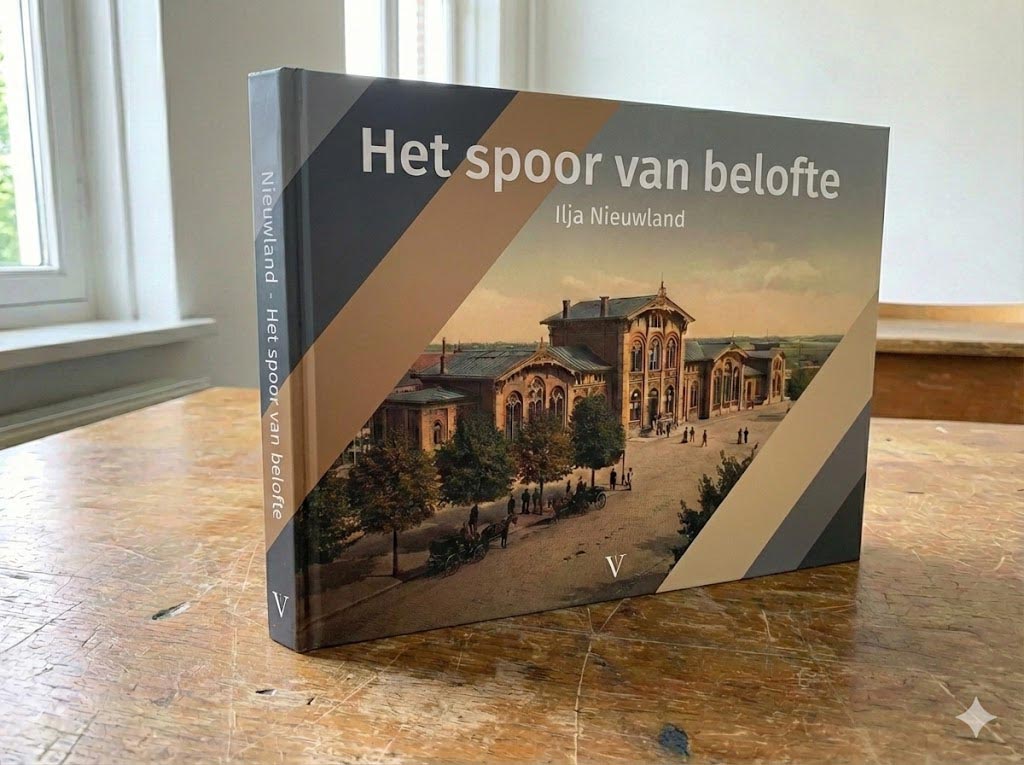
Het spoor van belofte. Een geschiedenis van de lijn Harlingen-Heerenveen (in Dutch & Frisian)
How a Cancelled Railway Line Might Have Created a Different Future (in Dutch)
After the opening of the first two Dutch railway lines around 1840, progress on the national railway network was slow. The initiative was left to private parties, who often shied away from the financial and administrative risks. It was not until 1860 that the government took a larger share and decided to build a dozen state-owned lines.
One of the most important of these was a connection from Harlingen to Germany via Leeuwarden and Groningen (Line B). The only open seaport in the Netherlands was thus to become an important element in its national trade. However, the connection with the Prussian Rhineland, the powerful industrial centre of Germany, was still a cumbersome one.
Plans to build a direct connection from Harlingen to Salzbergen had been circulating since the 1850s, but it was not until 1865 that various Frisian dignitaries took the initiative to further develop these ambitions. The Noorder-Spoorweg-Maatschappij (Northern Railway Company) project was approached on a grand scale.
The archives of Tresoar still contain the evidence: almost a hundred monumental plates and ten thick folders full of plans. Every detail was carefully considered—stations in neo-Gothic style, locomotives and carriages, points, rails, switches and bridges; even the fences along the route were worked out in drawings. Surveyors travelled through Friesland and compiled cadastral maps; lawyers worked on expropriation plans and engineers calculated gradients and curves.
So why don’t we take the train from Harlingen to Bolsward every day? The exact reason is shrouded in a fog of bureaucracy and failed financing. Perhaps the costs were too high after all, political interests came into play and investors lost confidence. In any case, the plans faded, the folders were closed and the drawings were put away.
This book assumes that the project was never cancelled, and describes a functioning railway line as it would have existed for almost a century and a half, in 2025. I will reflect on the Fryslân that could have been and that looked very different from what we ultimately got.
Stolen Symphonies. The Unraveling of Hans Franke’s Illegitimate Musical Legacy (in English)
Nazis, plagiarism and orchestras in the Sudetenland. And much more besides. Not happy with the title yet, but it’ll do as a working title.