
Halfway along Amsterdam’s Gerard Doustraat, in the De Pijp neighbourhood, we find Résonance: a small concert venue and violin maker’s workshop. A few chairs, a desk to the left, and a surprising number of paintings on the walls – most of them impressionist-style landscapes. Here, music and painting come together, as owner Eric Matser explains:
I once came across that painting hanging in the corner, and it was painted by Gerard von Brucken Fock (1859-1935). I remembered the name, because I had been interested in the history of Dutch music since my youth. And then I saw the painting. It wasn‘t expensive, so I bought it. And that is how my interest began in a largely forgotten composer who was nevertheless quite important.
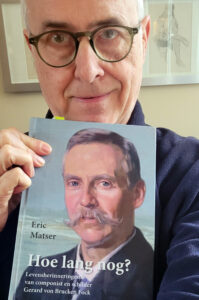
In 1959, a kind of proto-biography was published. It contains many quotations from his memoirs and some excerpts from letters. It was written by an old friend of his, Mrs Dozy-de Stoppelaar, and it revealed an utterly romantic figure: a religious fanatic, searching all his life, never finding anything lasting. Though, with hindsight, it was not quite as bad as all that. That first prompted me to start thinking in terms of a novel, with a sort of mission behind it: to make him better known. I thought: how can I make him a more familiar name? Not through a scholarly article, because that is for the in-crowd. So I would write the great novel that would put him on the public stage. That was, of course, far too ambitious. I have no literary training, and my writing style and imagination were not really up to the task. So what then? And a friend of mine, after reading a few pieces, eventually concluded that I should not write a novel, but a biography.
And that became more and more enjoyable, because I thought: ah, that man and his oeuvre are mine! I am more of a researcher than a writer anyway, so I dug deep into the archives. His personal papers are in Middelburg; his compositions are in The Hague. I did not get the impression that anyone had looked at them in all those years. There, too, I was seen as the specialist. I felt that more and more, and it also created a certain pressure: now I really have to live up to it. Someone has to stick his neck out, otherwise it will not happen and a composer like that will be forgotten. And I felt that very strongly.
It is a many-headed monster: I am writing about a man, a composer and a painter. Well, you can look at the paintings and tell a story about them: this is roughly where he was, and then he was there. But with music it is different. You have little more than the contemporary reviews and criticism: by Mr Rutters and Mr Vermeulen and Mr Pijper, and so on. And from their style and manner of criticism you can see that the latter two were completely biased. They were stuck in a rut; they had vested interests, and they were composer-critics themselves. That is a combination you see a hundred times over, because you could not make a living from composing. So you had to do something else, and then somewhere you were asked to write music reviews. It was a bit inbred, shall we say. I did not want to pass judgement, no rankings. I tried to be cautious in saying whether something was good or not. But there were also certain things I was sure were good, and I said so.
I was able to publish the biography with [publishing house] Verloren. They were convinced straight away; they did not hesitate for a moment. But we are now working on a second edition, because the first one was a bit of a mess. Others may not see that, but as a biographer I know where it is not right. That has been painful for years: if only I had paid more attention, if only I had taken more time. Because I was under pressure. It became a many-headed monster: you have to describe a life, and you are dealing with an oeuvre that is unknown. That is also why we released CDs: a double CD and then another one. That biography is also about heritage and memory culture.
If I may take a step back. You see that painting, you become interested in the man, and you are professionally involved in music. At what point do you begin to take an interest in the music?
Well, actually right away. In that red book by Mrs Dozy-de Stoppelaar, I found a quotation from the Memoirs: ‘I finished my cello sonata in [the capital of the Dutch province of Zeeland, IN] Middelburg.’ That was at his mother‘s house, on Dam Square. And somewhere else it says that he played the sonata in Paris. And I thought: yes, that is nice, because I am a cellist myself. Good cello sonatas were very rare in the Netherlands at that time; there were almost none. So I took a look at it and started playing it. And I thought: well, it is good. Shortly afterwards, I received a message from Larissa Groeneveld and Frank van der Laar, with whom I had been in touch about the piano pieces. And Frank said: yes, we are going to record them. That music came out very quickly. As a biographer, you immediately notice that music plays a very important role in that man‘s life. It is his main activity; he is more of a composer than a painter.
But he gave up a hundred times: ‘I’m quitting.’ Because of course criticism gets to you when it comes at you again and again. If you are constantly being hammered like that, you break, and he broke several times. Yes. And then there is a very interesting question: was that criticism justified? What is the truth? I find that interesting to talk about. Is it second or third rate? Or is it perhaps almost first rate? Or just below the top?
After reading the biography, I came across a review of the first performance of his First Symphony. ‘Oh, he is improving,’ says the critic. Well, that is quite nice. Because [Von Brucken Fock] had recently composed a Tragic Overture, which is not nearly as good. And then suddenly, in 1886, it happens. It is his first year of marriage. He does not write much about it, but to me it seems clear that he is very happy. And then comes that symphony. And the First Viola Sonata, a gem, which was also reviewed as a gem at the time.
That symphony was also a gem, according to critics, though one that leaned heavily on Beethoven. Critics are always looking for a somewhat personal style. That is fine, but then you quickly end up throwing the baby out with the bathwater. Because they should really have added: ‘for a 26-year-old.’ Julius Röntgen expresses his appreciation for the introduction to the fourth movement. He thinks: he can do it. And then in 1888, Von Brucken Fock suddenly becomes a critic for De Amsterdammer newspaper.He was simply a rising star, a composer like Vermeulen, who also had to write a great deal in his early years and did not really get a chance to prove himself. That is why he gets that job as a critic. And then it turns out that he writes very well about music, that he knows his classics and that he has taste. This results in good, balanced reviews. He does not like Wagner, but he can also explain why he does not like Wagner. It is all very thorough.
But after only two years, he is ashamed of those reviews and leaves Amsterdam. He flees from his life as a man of independent means, because he considers it sinful. He leaves for Leipzig and after four years, he gives away all his money and household goods. By then he is already married to the young lady Marie Pompe van Meerdervoort. Naturally, she thought she had made a good match when she married him, but after two, three, four years, he gives away all his possessions. He simply goes his own way and she follows him around, in despair: what kind of man is this? And it stays that way for the rest of her life. They do love each other, but she always comes second. At the time, of course, that was a perfectly usual situation.
But she is articulate and intelligent. She can also play the piano and sing. But of course she cannot cope; this man is such an unguided missile. And her way of getting him back on track is to become ill, or to feign illness, or a bit of both. To the point where she really does become ill because of him and, at one point, even seems to be dying. And at that moment he thinks: if my attitude, my ideas, lead to this, then those ideas are not good, and something has to be done. Then he wants to be rid of his ideas.
A very rich character. For me. Very colourful, very romantic, and outspoken too, of course. And among Dutch composers, I think he is the most interesting man.
It looks similar to someone like Richard Hol, who also had quite a respectable career. All four of his symphonies sound fairly Beethovenian. It is just much more foursquare, not as explosive or adventurous, and less innovative. That was the eye-opener for me in Von Brucken Fock‘s First Symphony, because it contained all sorts of things I had not expected. That is one I have to think about. And the other is Jan van Gilse, who of course had a similar background. With the same torment.
Van Gilse is also in that interesting category of people, but with a completely different personality. Pijper was a very interesting man too: deeply troubled, frustrated, and in fact a cold man; very aggressive as well. That, I think, is what Von Brucken Fock lacks a little. He seems to turn his torment mainly inward, whereas Pijper bites, scratches and screams.
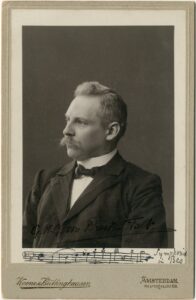
You also mentioned Vermeulen; in some ways he seems comparable to Von Brucken Fock, in that whole exalted and tormented aspect that is present in him too.
Yes. And he is also a similar loose cannon. Trying fifteen thousand things at once, but enormously talented as well. A huge talent for writing, too. I happen to be working on the second edition of the biography, and I have now reached those two symphonic poems. He has more, but after they are performed, Von Brucken Fock is actually waiting for Vermeulen to say something. ‘Why doesn‘t Vermeulen say anything about my French songs?’ Because he senses that Vermeulen, as a Francophile, is interested in those French songs. And there is no response. So he waits, for a year.
A year later, he reprises those French songs together with the two symphonic poems. And then suddenly Vermeulen comes out with a brilliant, but also very fierce, review:
‘I had thought that Von Brucken Fock, with his three French songs, which had travelled throughout the country, had taken a new direction. But that appears to have been very temporary. The restraint in the instrumentation, the precision of the rhythm, the correct declamation, and the spontaneity of impressionism – all things one must admire – have been lost again. Just as they were lost in his symphony, among other works.’
That is the Second Symphony. He heard it and tore it to shreds.
‘Mengelberg conducted two compositions for orchestra, Côte sauvage and Maannacht op zee. Nature pieces, of which one can say that no German has such mastery of the technical material. It is a virtuoso accumulation of impressions around a single theme that could not have been better treated or worse composed. Von Brucken Fock lacks no talent except compositional talent. What is missing here is the certainty of conception: the organic development of an emotion, which can always be achieved, with or without form.’
I think this is really brilliant.
‘It was worth it […] to hear all the interesting harmonic and instrumental effects. It was not worth it […] to be shaken around so aimlessly, from one climax to the next.’
Vermeulen can write, and I understand that he has a good ear for music. He also had a point about that Second Symphony. When I hear it, I does not grip me, unlike his First Symphony, which is a solid piece. But that is a different style, a different period. He does indeed look back, but he does so in a very original way. But in the Second… In the Third, he succeeds. At times. The First is wonderful. The Second… I am not so sure.
You often see that the more ambitious a work is, the more likely it is to collapse under its own weight.
I think that plays a role in the Second. And he himself says: ‘Mengelberg made a mistake in that performance,’ and then they have to redo that first movement, which was already so long. But if you wanted to perform it now, you would really have to cut it. Because what he hears, everyone hears, and at that point you have to protect the composer from himself. It all takes too long. And it is full of intermediate phases that lead nowhere. That is irritating, and he saw that very clearly. I am not someone who ultimately protects the man. I am too much of an honest scholar for that.
There are very few people in the Netherlands with whom you can have a conversation about this subject. That already shows that we are in uncharted territory here, but it can be spectacular if you open the right door and know how to make the connections. Then you have a wonderful story.
So you have someone who is very promising, but who may not quite live up to that promise in the public eye. Because his fickleness prevents him from building a consistent repertoire and a consistent career. Less talented figures, who do have that calm and steadiness, get much further. And then, at a certain point, such a man dies. His reputation lingers for a while, but then his work disappears.
Little has been discarded or is missing, and everything is available. It is not as if it was locked away for a while. Not at all. Look at that Cello Sonata. It is in manuscript, unpublished. He never got around to it. That is what you see all the time. He feels that he is dying. He does a few more things. He starts revising, a few years before his death. But of course he already feels it: “I have to do it now.” So he revised it in 1931. And he also says: ‘God will select something at some point.’ You have to remember that. It is very important. He says it a few times: ‘But I am counting on God. He may select something of value at some point.’ Because by saying that, he himself is saying that not everything is of value. And that is fine.
So I simply started playing God; I cannot put it any other way. Because I am selecting those things all the time. And what is fun? I actually think a lot more is good than he himself thought. And interesting. Because he has an inferiority complex. And he suffered from it himself: ‘If only it were a little less Beethoven.’ So he crosses it out, and you find a score with a wild cross on it: ‘Immature!’ So the composer himself also does something to ruin his legacy. And then you need someone like Matser to see through that and ignore the cross. And then to say to Marinus [Degenkamp]: ‘Make a demo of that, because I want to hear it.’ It turns out to be a masterpiece, one that can easily stand alongside Zweers’ Third Symphony. Different, but of the same calibre.
He does that ‘immature’ thing a few times. Also in his commentary in his Memoirs. ‘Yes, I still have a lot to retouch.’ And that is because he does not often sit with an orchestra and does not really feel at home with it. He simply does not hear an orchestra often enough, so it is strange to him; it is all theory. And he gets that theory from Berlioz‘s Instrumentation. And he fishes it all together. At one point he says: ‘Yes, I am going to write more sparsely, because I write too heavily for the orchestra.’ That is in the Second Symphony. And the Third is already much lighter. We know that now. So what he says about all that is also partly very true.
How did his reputation develop after his death? Did anything happen immediately? How is he remembered?
Of course, I have not researched that. How is he remembered? It is piecemeal. There is no consistent approach, but here and there there are initiatives. And then it stops again. And then it is ten years of this, or a hundred years of that. And then there is another celebration around him, especially in Zeeland, but not outside it. For example, there was an event – not a very pleasant one – after the flood in 1953. Because what did they think? Many people had died, but we have a Requiem by Mr Van Brucken Fock. So at the first commemoration in 1954, it was performed. And then Marie said: ‘Oh, oh, oh, I hope that goes well.’ Because a Requiem is a Catholic mass, and this is [orthodox protestant, IN] Zeeland. And she was right, because afterwards there was a smear campaign in the newspaper: ‘How is it possible to use a Catholic funeral mass to commemorate the [orthodox protestant] dead?’ Marie responded by saying: ‘The composer would not have cared.’ He was free in his thinking, and whether someone was Catholic or not did not matter to him at all. So she actually gave him the floor by saying: that was not an issue for him at all.
A very fragmented culture of remembrance, then, with no clear line running through it. I discovered that Von Brucken Fock had decided that a foundation should be established. That is the G.H.G. Von Brucken Fock Fund Foundation, set up after the death of his widow, and it has existed for a long time. Of course, that is where the assets were held. The foundation was led for a very long time by Mr Smit. And I think he was perfectly fine. He travelled around the country with slides and the story. Six people would turn up at such a meeting, and that was it.
When I had just started working on the Cello Sonata, I thought I would like to publish it, and I appealed to the foundation. Because the foundation‘s objective is general: to promote Dutch music and painting, not necessarily [Von Brucken Fock‘s]. And I had to point out to them that I was working on a biography of the fund‘s namesake. It took a long time before they were willing to consider it and give me money. In the end they did.
But what has happened in terms of commemoration, and why has it not been successful? This brings us to all those figures and foundations that have an influence on this and are difficult to persuade into action. But it is not an entirely negative story. Look, after the war, for example, there was the conductor Albert van Raalte, who performed Côte Sauvage in a studio recording. Well, that is quite remarkable. And then there is René Rakier, a pianist who also stuck his neck out for Von Brucken Fock, but also for other Dutch composers. So yes, there are all kinds of figures on the margins. I myself knew Nelly van der Spek. I do not think she is alive anymore, but I invited her to the book presentation. A phenomenal singer, truly phenomenal; she also worked with Harnoncourt and I do not know who else. That one song, Ritzelputzel, is fantastic, but that was back in the 1970s; each time, piecemeal.
So that legacy is simply available. But you have to be interested. Albert Clement, professor of musicology, also spent some time studying Von Brucken Fock. But he was also a Bach fanatic, so he went for Bach. Perhaps he has a point there, but that subject has also been explored in an entire library. As a professor, should you write yet another book about Bach? To be honest, I think Clement would have been better off focusing on Von Brucken Fock, as a musicologist and as a Zeeland native. Why didn‘t you write that biography?
I did not say that to him, of course. He wanted to offer me a PhD research project, and I would then obtain my doctorate at the Theological University of Apeldoorn. That did not happen, because I would have had to say during my defense that I thanked our Lord for His goodness. I really did not feel like doing that. But again, it is a small circle. And that is where the problem lies. And with music, if it is not played, it is dead; it does not exist. So really, we are still at the beginning.
At the moment, we are in a relatively unique position. We can view and download a great many scores on the internet. What is more, we can easily turn them into sound ourselves. The software is affordable, or even free, and the standard is now such that it is easy to listen to. Does this greater accessibility make any difference?
Well, absolutely. And there is a revolution in digital technology and AI. That is really great. Over the last five years, I think, things has been moving fast, and it could become really explosive. But then it remains plastic; I call that plastic music. You are not going to get anywhere with that. All year long I have been thinking: I am flogging a dead horse. Yes. As long as it stays within scholarship, it is fun for us. And inspiring, and so on. But if it does not take that step out to a wider audience, then yes, it remains a sombre story. Yes, that made me a bit depressed. Because I am sitting there in a state of supreme bliss, listening to such a symphony, and they are beautiful pieces. Varied too, because there is an early work, a middle work and a somewhat later work: you see a brilliant development within one form, the symphony.
It is also a prestigious form for a composer.
The pinnacle, in fact. The few scholars who have studied it, including [Eduard] Reeser, say that Opus 15 is among the best piano music ever written in the Netherlands. Well, that is settled. And Von Brucken Fock himself says about his much later preludes (1924-1931) that I discovered, ‘It is deeper and better than my 24 Preludes Opus 15.’ Voilà, at that point I get down on my knees and I think: well, I will just play God. Now I have put the late preludes on YouTube, so everyone can see and hear them. Yes. So the audience is already sitting at their computers. But I would like to have them in the concert hall.
If you look at the classical-music market, that is going to be a struggle. But you also see that the markets for recorded and live music have little to do with each other. And now something else is happening. The iron repertoire is being shaken up a little, to ensure that certain groups – particularly women and people from other ethnic groups – receive more attention. That gives me a little hope. But it also means that the rest will probably be buried even deeper than it already is.
Yes, it is going to be problematic. Yes. So let us just muddle through for now. So far, my story has been a bit negative, perhaps. That is the frustration coming through. But if I put an end to that for now: I have a concert hall here with young pianists. Next year, on 1 February, a few people will be coming again. Aiden Mikdad – well, he is becoming a big name, a young lad. When such young pianists, I’m also mentioning Jorian van Nee, continue to come over the years, the fire will be kept warm.
That is the idea. And outside this, I try to do my best; that is all I can do. In the past, the Radio Philharmonic Orchestra still had the task of performing Dutch music. Well, I am not getting very far with that. I am in contact with Donemus and the Orchestra of Zeeland (Zeeuws Orkest), and they are enthusiastic now. So let us just hope that it will work out a little through those channels.
More information
- More about Eric Matser’s biography of Gerard von Brucken Fock (2nd edition, 2025) at Verloren Publishers.
- For soundbites from Van Brucken Fock’s works (and some entire works, check out Matser’s YouTube channel.
- Hear Matser talk (in Dutch) about his work on Verloren Publisher’s YouTube channel.
Cover photograph
Dutch composer and painter Gerard von Brucken Fock (1859–1935) playing the piano, his wife behind him.
This interview was conducted (in Dutch) as part of the background to my upcoming book Stolen Symphonies. I have chosen to publish it in its entirety, both because I want to give full disclosure about my background material, and because I thought it was an interesting conversation. I have attempted to preserve Matser's unique way of speaking in the English translation.